

























Understanding High-Context and Low-Context Cultures

MNAINDONESIA.ID -
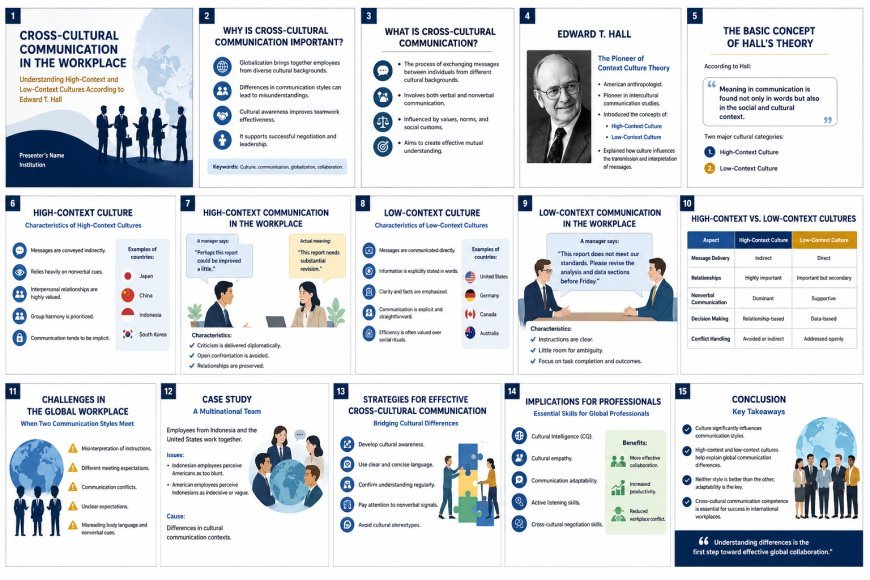
Cross-Cultural Communication in the Workplace
Understanding High-Context and Low-Context Cultures According to Edward T. Hall
Slide 2: Introduction
Why Is Cross-Cultural Communication Important?
- Globalization brings together employees from diverse cultural backgrounds.
- Differences in communication styles can lead to misunderstandings.
- Cultural awareness improves teamwork effectiveness.
- It supports successful negotiation and leadership.
Keywords: Culture, communication, globalization, collaboration.
Slide 3: Definition of Cross-Cultural Communication
What Is Cross-Cultural Communication?
- The process of exchanging messages between individuals from different cultural backgrounds.
- Involves both verbal and nonverbal communication.
- Influenced by values, norms, and social customs.
- Aims to create effective mutual understanding.
Slide 4: Edward T. Hall
Edward T. Hall
The Pioneer of Context Culture Theory
- American anthropologist.
- Pioneer in intercultural communication studies.
- Introduced the concepts of:
- High-Context Culture
- Low-Context Culture
- Explained how culture influences the transmission and interpretation of messages.
Slide 5: The Basic Concept of Hall’s Theory
Culture as a Communication Context
According to Hall:
"Meaning in communication is found not only in words but also in the social and cultural context."
Two major cultural categories:
- High-Context Culture
- Low-Context Culture
Slide 6: High-Context Culture
Characteristics of High-Context Cultures
- Messages are conveyed indirectly.
- Relies heavily on nonverbal cues.
- Interpersonal relationships are highly valued.
- Group harmony is prioritized.
- Communication tends to be implicit.
Examples of countries:
- Japan
- China
- Indonesia
- South Korea
Slide 7: High-Context Communication in the Workplace
Workplace Example
A manager says:
"Perhaps this report could be improved a little."
Actual meaning:
"This report needs substantial revision."
Characteristics:
- Criticism is delivered diplomatically.
- Open confrontation is avoided.
- Relationships are preserved.
Slide 8: Low-Context Culture
Characteristics of Low-Context Cultures
- Messages are communicated directly.
- Information is explicitly stated in words.
- Clarity and facts are emphasized.
- Communication is explicit and straightforward.
- Efficiency is often valued over social rituals.
Examples of countries:
- United States
- Germany
- Canada
- Australia
Slide 9: Low-Context Communication in the Workplace
Workplace Example
A manager says:
"This report does not meet our standards. Please revise the analysis and data sections before Friday."
Characteristics:
- Instructions are clear.
- Little room for ambiguity.
- Focus on task completion and outcomes.
Slide 10: High-Context vs. Low-Context Cultures
|
Aspect |
High-Context Culture |
Low-Context Culture |
|
Message Delivery |
Indirect |
Direct |
|
Relationships |
Highly important |
Important but secondary |
|
Nonverbal Communication |
Dominant |
Supportive |
|
Decision Making |
Relationship-based |
Data-based |
|
Conflict Handling |
Avoided or indirect |
Addressed openly |
Slide 11: Challenges in the Global Workplace
When Two Communication Styles Meet
Potential challenges:
- Misinterpretation of instructions.
- Different meeting expectations.
- Communication conflicts.
- Unclear expectations.
- Misreading body language and nonverbal cues.
Slide 12: Case Study
A Multinational Team
Employees from Indonesia and the United States work together.
Issues:
- Indonesian employees perceive Americans as too blunt.
- American employees perceive Indonesians as indecisive or vague.
Cause:
- Differences in cultural communication contexts.
Slide 13: Strategies for Effective Cross-Cultural Communication
Bridging Cultural Differences
- Develop cultural awareness.
- Use clear and concise language.
- Confirm understanding regularly.
- Pay attention to nonverbal signals.
- Avoid cultural stereotypes.
Slide 14: Implications for Professionals
Essential Skills for Global Professionals
- Cultural Intelligence (CQ).
- Cultural empathy.
- Communication adaptability.
- Active listening skills.
- Cross-cultural negotiation skills.
Benefits:
- More effective collaboration.
- Increased productivity.
- Reduced workplace conflict.
Slide 15: Conclusion
Key Takeaways
- Culture significantly influences communication styles.
- High-context and low-context cultures help explain global communication differences.
- Neither style is better than the other; adaptability is the key.
- Cross-cultural communication competence is essential for success in international workplaces.
"Understanding differences is the first step toward effective global collaboration."
What's Your Reaction?